
By Ogbuenyi Precious Nkem
Director of Development, Heart of Unity and Tolerance Foundation (HUT Foundation)
Introduction
Nigeria’s struggle with tribalism is neither incidental nor accidental. It is deeply embedded in the country’s historical formation, political economy, and everyday social interactions. From the early post-colonial period to contemporary electoral politics, ethnic identity has repeatedly surfaced as both a tool of mobilisation and a fault line for conflict. Whilst Nigeria is often celebrated for its diversity (comprising over 250 ethnic groups and more than 500 languages), that same diversity has been politicised in ways that undermine peaceful coexistence and national cohesion.
This essay argues that tribalism in Nigeria is not the product of ancient cultural hostilities but rather a socially constructed and politically sustained phenomenon. Drawing on sociological theory, historical analysis, and insights from the Heart of Unity and Tolerance Foundation (HUT Foundation) survey conducted amongst young urban Nigerians, this essay demonstrates how ethnic identity becomes activated in contexts of competition, perceived exclusion, and elite manipulation. It further contends that meaningful peacebuilding in Nigeria requires addressing the structural incentives that reproduce tribalism, rather than relying solely on symbolic unity narratives or superficial integration programmes.
As Director of Development at the HUT Foundation, a Nigerian non-governmental organisation committed to peaceful coexistence and non-discrimination based on tribe, religion, and gender, this analysis is informed not only by academic inquiry but also by engagement with civic education, dialogue initiatives, and community-level peacebuilding. The perspectives presented here therefore sit at the intersection of scholarship and practice, reflecting both theoretical understanding and the lived realities of communities affected by ethnic division.
Identity, Belonging, and the Social Construction of Tribe
Ethnic identity is often treated in public discourse as something fixed and inherited—an immutable characteristic passed down through bloodlines. Yet sociological scholarship presents a more nuanced understanding. Fredrik Barth’s constructivist approach emphasises that ethnicity is defined less by internal cultural content and more by the social boundaries that distinguish “us” from “them”. These boundaries are neither static nor inevitable; they become salient under particular social and political conditions.
In Nigeria, tribal identity frequently operates as a latent marker—present but not always foregrounded. Many Nigerians navigate daily life without overt reference to tribe, particularly in urban, multi-ethnic settings where professional relationships and commerce cross ethnic lines. However, moments of political competition, economic uncertainty, or perceived threat tend to activate ethnic consciousness. At such points, individuals may feel “more Igbo”, “more Yoruba”, or “more Hausa” than Nigerian, not because identity has fundamentally changed, but because context has shifted the salience of particular identity markers.
This fluidity is critical to understanding why tribalism intensifies during elections or periods of instability. Identity is not the cause of conflict in itself; rather, it becomes a vehicle through which grievances are articulated and mobilised. Survey data from young Nigerians illustrate this dynamic: over 70 per cent of respondents assigned at least some importance to tribal identity, despite many claiming it was not central to their self-conception. This paradox suggests that tribal identity exists in a dormant state, ready to be activated when circumstances demand it.
The finding that 83.8 per cent of respondents had parents from the same tribe further demonstrates how ethnic identity is transmitted intergenerationally through family structures, language use, and social expectations. Tribalism is thus learned early in life and reinforced through everyday socialisation processes such as casual stereotypes, jokes, and community narratives, making it particularly resistant to change.
Colonial Legacies and the Architecture of Division
Nigeria’s colonial history laid the foundation for the politicisation of ethnic identity. British indirect rule did more than administer territory efficiently; it entrenched ethnic boundaries and institutionalised difference in ways that continue to shape Nigerian politics today. By governing through traditional authorities and maintaining separate administrative structures for different regions, colonial rule hardened identities that had previously been fluid and context-dependent.
The 1914 amalgamation of the Northern and Southern protectorates was not an exercise in nation-building but an economic calculation. Lord Frederick Lugard brought together diverse groups without fostering a shared political identity, whilst colonial policies ensured that Nigerians related to the state primarily through ethnic intermediaries. The British ruled the North through Islamic Emirs, restricting Western education and Christian missionary activity to preserve the traditional power structure. In the South, missionaries and schools were permitted, creating a new class of educated, English-speaking Nigerians who began demanding independence.
This administrative separation created mutual suspicion between regions. The British portrayed Southern elites as “intruders” to Northerners, whilst Southerners felt the North was being used to “hold back” progress. These divisions erupted violently in 1953 when Southern politicians moved a motion for self-government. Northern leaders, fearing Southern domination, rejected the timeline. When a Southern delegation visited Kano to campaign for independence, four days of violent clashes ensued, resulting in approximately 36 deaths and hundreds of injuries. This marked the first time that political disagreements in Lagos led to large-scale, lethal ethnic violence in a northern city.
Post-independence politics inherited this structure. Political parties formed along ethnic lines—the Northern People’s Congress (NPC) representing the Hausa-Fulani, the Action Group (AG) representing the Yoruba, and the National Council of Nigeria and the Cameroons (NCNC) representing the Igbo. Because the British had established a system in which government control was the primary route to wealth, each group feared that electoral defeat would result in marginalisation. This zero-sum competition ultimately contributed to the Biafran Civil War (1967–1970), a conflict rooted in the marginalisation of the Igbo people, control of oil resources, and deep-seated ethnic, political, and economic tensions.
The British departed in 1960, but the “divide and rule” architecture remained. Ethnic identities became more firmly entrenched, with many Nigerians identifying as “Igbo” or “Hausa” first and “Nigerian” second. This legacy continues to shape contemporary politics, demonstrating that Nigeria’s tribal divisions are not ancient animosities but the product of specific historical processes that can, in principle, be addressed and transformed.
Tribalism as Competition: Insights from Conflict Theory
Conflict theory provides a valuable lens through which to understand the persistence of tribalism in Nigeria. In a context where the state remains the primary allocator of jobs, infrastructure, and opportunity, access to political power becomes a high-stakes competition. Ethnic identity offers a ready-made framework for organising that competition, particularly when formal institutions are perceived as weak or partisan.
Rather than viewing tribalism as irrational prejudice, conflict theory suggests it can function as a rational (though destructive) response to structural inequality. When individuals believe that resources are distributed along ethnic lines rather than merit, they are incentivised to seek protection and advantage through their own group. This perception of zero-sum competition fuels mistrust and undermines national solidarity, creating a vicious cycle in which tribalism becomes both cause and consequence of institutional weakness.
Survey data from young Nigerians reinforce this interpretation. A striking 70.3 per cent reported having experienced discrimination or prejudice based on tribal affiliation, whilst 97.3 per cent agreed that tribalism constitutes a major problem in Nigeria. Such experiences shape how individuals interpret social outcomes, often reinforcing the belief that tribe, rather than merit, determines access and opportunity. When preferential treatment is perceived as ethnically motivated, citizens retreat into the perceived “security” of their ethnic group, hardening the “us versus them” boundary.
The situation in Nigeria’s oil-rich Niger Delta exemplifies this dynamic. Residents witness billions of dollars’ worth of oil being extracted from beneath their land whilst their water remains polluted and their youth unemployed. They observe the prosperous capital city of Abuja and perceive that their resources are being used to develop another region’s infrastructure. This intense sense of relative deprivation—the feeling of being poor not in absolute terms but relative to another group’s gains—creates fertile ground for ethnic mobilisation and conflict.
Elite Manipulation and the Politics of Grievance
Whilst structural conditions create the terrain for tribalism, political elites often supply the spark. Elite manipulation theory highlights how leaders activate ethnic identity to mobilise support, deflect accountability, and maintain power. In Nigeria, this strategy has been repeatedly observed during electoral cycles, where rhetoric subtly or overtly frames politics as a contest between groups rather than a debate over policy.
Survey respondents consistently identified political actors as primary drivers of tribalism, noting that politicians exploit ethnic identity during elections to distract from governance failures and deepen divisions. This perception aligns with historical patterns: instead of campaigning on complex policy platforms, politicians claim, “If you don’t vote for me, that other group will take everything. It is our turn to rule.” Such rhetoric transforms elections from competitions over governance into ethnic survival contests.
The 2023 presidential election provided stark illustrations of this dynamic. Politicians employed “dog-whistle” politics, phrases that appear innocuous to outsiders but signal “us versus them” to their base. A presidential aspirant’s use of the Yoruba phrase “emi lokan” (meaning “it is my turn”) whilst addressing his ethnic group exemplified how ethnic entitlement is invoked as a political strategy. Social media bots were deployed to amplify divisive voices and create the illusion of massive ethnic grassroots movements, strengthening harmful biases and fuelling inter-ethnic hatred.
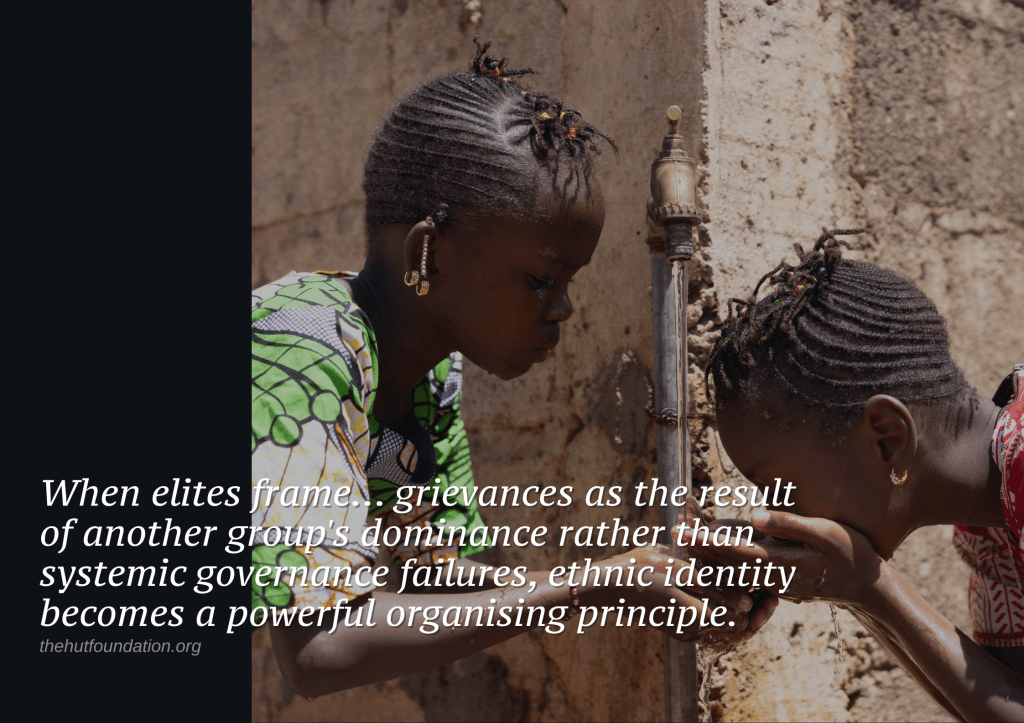
Grievance theory complements this analysis by explaining why such mobilisation resonates. Grievances rooted in unemployment, marginalisation, or underdevelopment are real and deeply felt. When elites frame these grievances as the result of another group’s dominance rather than systemic governance failures, ethnic identity becomes a powerful organising principle. The synergy between elite manipulation and grievance is particularly dangerous: leaders provide narratives that simplify complex governance failures into ethnic blame, whilst citizens, already experiencing hardship, find those narratives emotionally compelling.
A leader without a grievance to exploit has no base of support; a population with grievances but no leadership often has no voice. Both elements are required for conflict to ignite. This reality underscores why addressing tribalism requires both institutional reform to reduce grievances and accountability mechanisms to penalise divisive rhetoric.
Youth Perspectives and the Future of National Cohesion
Focusing on young urban Nigerians offers insight into the future trajectory of tribalism in the country. Survey data reveal a critical tension: whilst an overwhelming majority recognise tribalism as a major national problem, their lived experiences suggest that tribal identity continues to shape trust, opportunity, and belonging in profound ways. Many young people express discomfort with ethnic prejudice and articulate sophisticated critiques of elite manipulation, yet they simultaneously report experiencing discrimination and navigating social environments where tribal affiliation matters.
This tension reflects a broader paradox: awareness of tribalism does not automatically translate into its dissolution. Without institutional reform and deliberate social intervention, even well-intentioned individuals remain embedded within systems that reward ethnic alignment. Respondents’ proposals for change emphasised improved civic education, teaching Nigerian history in ways that promote shared identity rather than ethnic competition, leadership accountability, and national integration initiatives. These suggestions indicate both recognition of the problem’s complexity and readiness for meaningful reform.
From the perspective of civil society and peacebuilding organisations such as the HUT Foundation, this underscores the importance of combining education with structural advocacy. Changing attitudes is necessary but insufficient without parallel efforts to address the political and economic incentives that sustain division. Grassroots dialogue initiatives that bring together individuals across ethnic lines offer practical pathways for rebuilding trust at the community level, but such efforts must be complemented by reforms that make merit-based systems credible and ethnically inflammatory rhetoric costly.
Towards Peaceful Coexistence: Rethinking Solutions
Efforts to address tribalism in Nigeria have often relied on symbolic gestures of unity—national slogans, federal character principles, and integration programmes treated as bureaucratic requirements rather than genuine opportunities for cross-cultural engagement. Yet the evidence suggests that deeper change is required. The near-unanimous recognition amongst survey respondents that tribalism undermines national unity indicates widespread desire for transformation, but achieving it demands confronting uncomfortable realities about power, resources, and accountability.
First, civic and historical education must move beyond rote narratives to foster critical engagement with identity, power, and shared responsibility. Teaching Nigerian history as a story of ethnic competition reinforces the very divisions peacebuilding seeks to overcome. Instead, curricula should emphasise interdependence, collective struggles, and the constructed nature of ethnic boundaries, equipping young people to question rather than reproduce tribal biases.
Second, political accountability must be strengthened to discourage divisive rhetoric and reward inclusive leadership. Existing laws addressing hate speech and incitement are rarely enforced consistently, allowing politicians to weaponise ethnicity without consequence. Electoral bodies and media regulators must collaborate to monitor and penalise ethnically inflammatory messaging, particularly during election periods when such rhetoric is most damaging.
Third, institutions that allocate resources—from public service recruitment to infrastructure development—must demonstrably prioritise merit and transparency over ethnic considerations. When citizens perceive institutions as fair, reliance on tribal identity as a survival mechanism diminishes. Conversely, when institutions appear ethnically biased, they validate the very tribalism they ostensibly oppose.
Finally, media and digital platforms play a critical role in shaping public discourse. In an era where misinformation and ethnic dog-whistles spread rapidly through social media, conflict-sensitive communication is essential. Journalists require training on responsible reporting of ethnic tensions, whilst platforms must address algorithmic amplification of divisive content and coordinated disinformation campaigns.
Conclusion
Tribalism in Nigeria is not an immutable feature of society, nor is it the inevitable outcome of diversity. It is a socially constructed and politically sustained phenomenon, shaped by historical legacies, structural inequality, and elite strategy. Understanding this reality is essential for moving beyond superficial solutions towards meaningful peacebuilding.
The survey data presented in this essay demonstrate that young Nigerians are acutely aware of tribalism’s corrosive effects on national unity, social trust, and individual opportunity. Their lived experiences reveal how ethnic identity—though often dormant—becomes activated during moments of competition or perceived threat, reinforcing cycles of mistrust and exclusion. Yet their recognition of the problem also signals readiness for change, provided that interventions address root causes rather than symptoms.
For Nigeria to move towards genuine national cohesion, identity must cease to be a currency of political competition and instead become one element within a broader, inclusive civic framework. This requires confronting the colonial legacies that institutionalised ethnic division, dismantling the structural incentives that make tribal mobilisation profitable for elites, and building institutions perceived as fair by all citizens regardless of ethnic background.
For organisations committed to peaceful coexistence, including the Heart of Unity and Tolerance Foundation, the task ahead is both challenging and urgent. It demands sustained engagement across education, governance, media, and community dialogue. Educational initiatives must challenge the normalisation of tribal bias from early childhood. Leadership must be held accountable for rhetoric that deepens division. Institutions must earn credibility through demonstrated fairness. And communities must create spaces for genuine cross-ethnic encounter and dialogue.
Only through such comprehensive efforts can Nigeria begin to loosen the grip of tribalism and realise the promise of unity within diversity. The path forward is neither simple nor swift, but the alternative—continued cycles of ethnic mobilisation, conflict, and missed opportunities for collective prosperity—is unacceptable. Nigeria’s future depends on the courage to confront tribalism’s roots and the commitment to build systems that reward shared citizenship over ethnic allegiance.
References
Baydhowi Baydhowi, et al. (2023). Perception of threat and national identity: Investigation of the mediating role of collective self-esteem. CelPress.
Cederman, Lars-Erik, Andreas Wimmer, and Brian Min. (2010). Why do ethnic groups rebel? New data and analysis. World Politics 62 1 (87-119).
Curle, Clint. (2020). Us vs. Them: The process of othering. Canadian Museum for Human Rights.
Eghosa E. Osaghae and Rotimi T. Suberu. (2005). A History of Identities, Violence, and Stability in Nigeria. Centre for Research on Inequality, Human Security and Ethnicity.
Emmanuel Achus Jah, et al. (2023). Identity Conflict in Nigeria: An Analytical Deconstruct. Nigerian Army University.
Mariotti, Claudia. (2022). Elite Theory. 10.1007/978-3-030-44556-0_67.
Nelson, Ediomo-Ubong Ekpo and Emmanuel J. Umontuen. (2022). Identity Politics and Conflict in Nigeria: A Criminological Focus on Oil and Oil Producing Communities in the Niger Delta. University of Uyo.
Parmar, Alpa, Rod Earle, Coretta Phillips. (2022). The British Journal of Criminology. Volume 63, Issue 4. 811–827.
Pizzolo, Paolo. (2022). The Greed versus Grievance Theory and the 2011 Libyan Civil War: Why grievance offers a wider perspective for understanding the conflict outbreak. Small Wars Journals.
Varshney, Ashutosh. (2009). The Oxford Handbook of Comparative Politics. 274–294.
 The HUT Foundation
Leave a comment